Our Story
A Brand Born
Although it has become prominent with a well-known Turkish Poet Özdemir Asaf, it has been subject to many other poems, novels and songs in Turkey and abroad as well. Özdemir Asaf calls Lavinia after she leaves him: "I won`t ask you not to go, but don`t go, Lavinia!" Hilmi Yavuz talks to his pale Lavinia: "For sure, not mourning but summer suits you."
In Shakespeare`s tragedy Titus Andronicus, Lavinia takes the stage as the beautiful daughter of General Titus of the Roman army. Unfortunately, her life is ended by her own father after all the misfortunes she has lived.
But despite those who buried herself and wanted her to be forgotten, Lavinia is reborn as a flower with a stunning beauty from where she was buried. Just like the Lavinia flowers with blue butterflies, reminding those who shared the same destiny in Srebrenica...
Lavinia, in Ursula K. Le Guin`s novel named also Lavinia with reference to the story of Aeneid in mythology, appears as a strong character who rebels against the widespread views in a society dominated by men, where women do not have the right to choose and do not have a voice. She neither obeys the orders of his father, the King of Latium, nor of his mother the Queen. She follows her own dreams, and plays a key role in the establishment of the Roman Empire.
Although Lavinia is usually the reminiscent of death, separation, sorrow and misfortunes, it could be actually a symbol of change and transformation in many lives. That`s why, in Lavinia, we desperately need to see and smell the beauties, which do not fade, do not die, and do not disappear.
A Brand Born
on Water
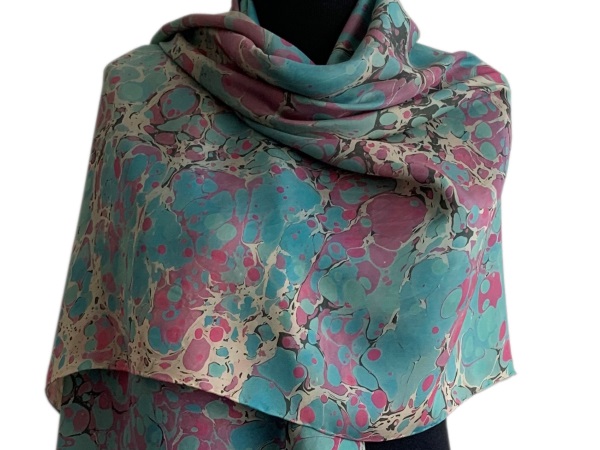
Lavinia was founded to bring the ancient Turkish art of ebru into dialogue with modern aesthetics. Each piece is the product of a moment that cannot be repeated: Born from the meeting of water, pigment, and an artist's hand.
We do not simply sell products. We share a moment, a process, an art. And we do this through the skilled hands and creative spirits of women artists.
Why "Lavinia"?
According to some authors, Lavinia is the name of perfect lover in dreams, or the recipe for unrequited love. For some others, it is the flower of death or just the freedom itself...Although it has become prominent with a well-known Turkish Poet Özdemir Asaf, it has been subject to many other poems, novels and songs in Turkey and abroad as well. Özdemir Asaf calls Lavinia after she leaves him: "I won`t ask you not to go, but don`t go, Lavinia!" Hilmi Yavuz talks to his pale Lavinia: "For sure, not mourning but summer suits you."
In Shakespeare`s tragedy Titus Andronicus, Lavinia takes the stage as the beautiful daughter of General Titus of the Roman army. Unfortunately, her life is ended by her own father after all the misfortunes she has lived.
But despite those who buried herself and wanted her to be forgotten, Lavinia is reborn as a flower with a stunning beauty from where she was buried. Just like the Lavinia flowers with blue butterflies, reminding those who shared the same destiny in Srebrenica...
Lavinia, in Ursula K. Le Guin`s novel named also Lavinia with reference to the story of Aeneid in mythology, appears as a strong character who rebels against the widespread views in a society dominated by men, where women do not have the right to choose and do not have a voice. She neither obeys the orders of his father, the King of Latium, nor of his mother the Queen. She follows her own dreams, and plays a key role in the establishment of the Roman Empire.
Although Lavinia is usually the reminiscent of death, separation, sorrow and misfortunes, it could be actually a symbol of change and transformation in many lives. That`s why, in Lavinia, we desperately need to see and smell the beauties, which do not fade, do not die, and do not disappear.